

What Patagonia Teaches Us About Storytelling and Trust
By Ellie Victor, Co-CEO
If you were to ask me which company I admire most for their brand positioning over the years, I'd say Patagonia is the gold standard. In 2021 and 2023, after 50 years in business, they were named America's Most Admired Company, topping Apple, IBM and Costco.
Patagonia shows what it means to deliver on its mission: "We’re in businss to save our home planet." Most companies think positioning is what they say. Patagonia demonstrates that positioning is what they're willing to do. Over decades, Patagonia has built extraordinary trust because it consistently takes actions that reinforce its mission, even when those actions challenge its products, business model, or industry.

Yvon Chouinard, founder of Patagonia. (Photo: Ben Baker/Redux)
I still remember hearing founder Yvon Chouinard speak at a Stanford Graduate School of Business Alumni Association event in 2011. The story that stuck with me was Patagonia's decision to switch to organic cotton.
When employees at Patagonia's Boston retail stores started getting sick, the company discovered that formaldehyde and other chemicals in its cotton clothing were circulating through the ventilation system. The products themselves were contributing to the problem.
True to form, Chouinard wanted to get to the root cause. He visited Patagonia's cotton suppliers and found what he described as a dead zone. The surrounding land was barren. Birds, bugs, and other signs of life were gone.
At that moment, he gave Patagonia 18 months to switch to organic cotton.
There was just one problem: there weren't enough organic cotton farms capable of supplying Patagonia's needs.
Rather than abandon the effort, Patagonia co-signed loans for farmers making the transition and even provided emergency funding to help them survive. Today, Patagonia uses 100% organic cotton and helped push the broader apparel industry in the same direction.
That's what makes Patagonia such a compelling storytelling case study. It's built on a series of bold decisions that repeatedly put its mission into action.
What follows are three lessons leaders can learn from Patagonia's approach to storytelling, trust, and brand building… if they're willing to challenge some of the same assumptions Patagonia did.
Lesson 1: Be Willing to Criticize Yourself and Your Industry
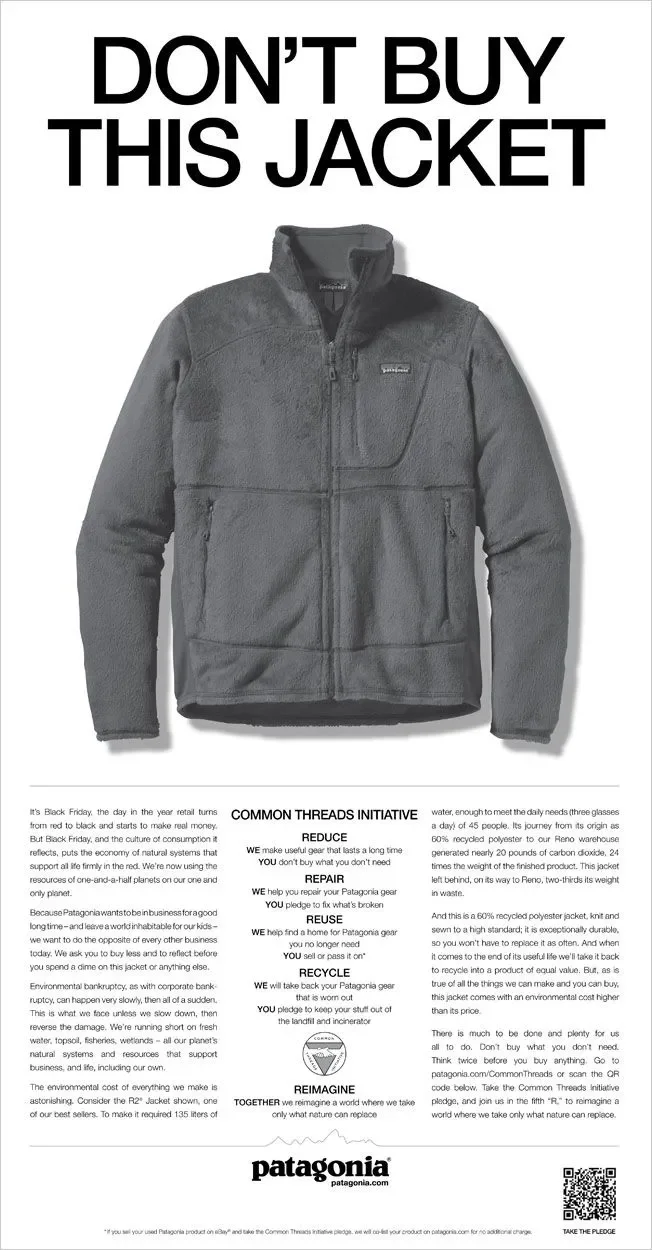
The bold Black Friday New York Times ad in 2011 flipped the script on consumerism, instead promoting environmentalism.
Today, one of marketer’s toughest challenges is to earn trust. Buyers are jaded. They’ve seen every promise and they’ve been burned. They’re immune to buzzwords and marketing claims that sound the same.
Can you imagine how your brand would stand out if you spoke the truth, even if it meant criticizing yourself or your industry?
Patagonia has repeatedly criticized itself and the industry for its harmful impact on the planet. Famously, on Black Friday, 2011, Patagonia took out a full page ad in the NY Times with the headline “Don’t Buy this Jacket,” above a photo of one of its zip up fleece jackets. The copy explained the controversial ad with this excerpt: “Black Friday and the culture of consumption it reflects put the economy of natural systems that supports all life firmly in the red.” It concluded, “Think twice before you buy anything.”
The ad went viral, generating an estimated $40–$50 million in free publicity for Patagonia. What could have been a risky admission became one of the most celebrated advertising campaigns ever created. Even more remarkably, Patagonia's sales increased by 30% the following year.
Thinking about your business practices and your industry, what truths are you willing to tell?
Lesson 2: Innovate Beyond Your Product
Most companies define innovation as improving what they sell.
Patagonia innovates around its mission instead.
Rose Marcario, Patagonia's CEO from 2014-2020, once shared that the leadership team would sit around asking themselves a provocative question: What could we do that is so bold our competitors would never follow? That mindset opened the door to a different kind of innovation. Instead of focusing only on better products, Patagonia looked for ways to advance its broader mission.
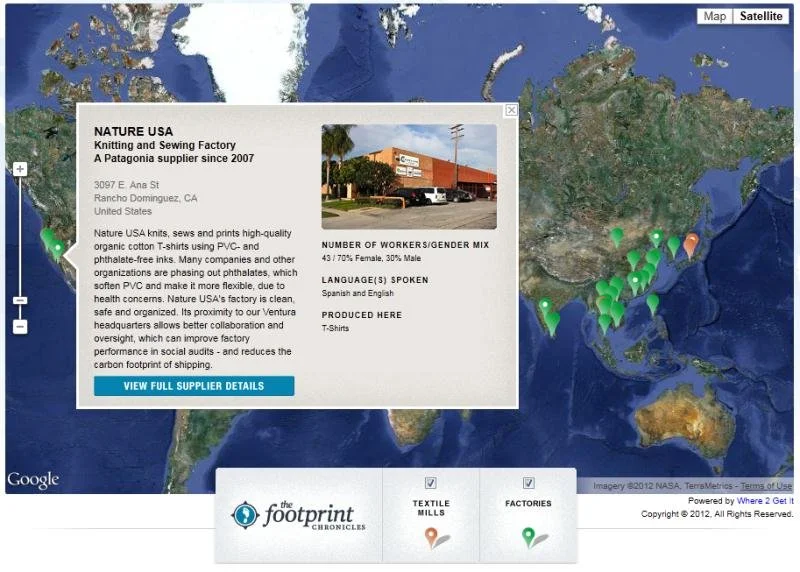
The Patagonia Footprint Chronicles reveal the environmental impacts of each global supplier.
One of the best examples is Footprint Chronicles. At a time when most apparel companies revealed as little as possible about their supply chains, Patagonia began pulling back the curtain. Customers can click on a product—or even scan information on its tag—and trace where it was made, learn about the factories involved, understand environmental impacts, and see the challenges Patagonia is still working to solve.
Footprint Chronicles didn't make a jacket warmer, lighter, or more durable. It made the company more transparent.
What's striking is how uncommon this level of transparency remains. Imagine if every package of bacon, gallon of milk or smartphone allowed consumers to easily trace where it came from, understand its environmental footprint, and see the conditions under which it was produced. Most companies still treat that information as something to obscure. Patagonia treated it as something to share.
In doing so, Patagonia didn't just innovate for itself. It raised expectations for an entire industry. Consumers began asking questions they hadn't asked before, and competitors faced pressure to provide greater visibility into their own supply chains.
As AI reshapes industries, I can't help but wonder who will create the Footprint Chronicles of AI. Which company will be the first to openly discuss where training data came from, what its algorithms are trained to do, how much energy was consumed, and how many jobs are created, transformed, or displaced by its technology? Patagonia's example suggests that transparency may not be a liability. It may be the foundation of trust.
Patagonia made the decision that customers deserved to know the truth, even when the truth wasn't perfect.
Lesson 3: Redefine What a Company Is For
Patagonia has spent decades challenging traditional assumptions about the role of business. It helped launch 1% for the Planet, committing a portion of sales to environmental causes. It was among the early companies to become a Certified B Corporation, expanding the definition of success beyond shareholder returns.
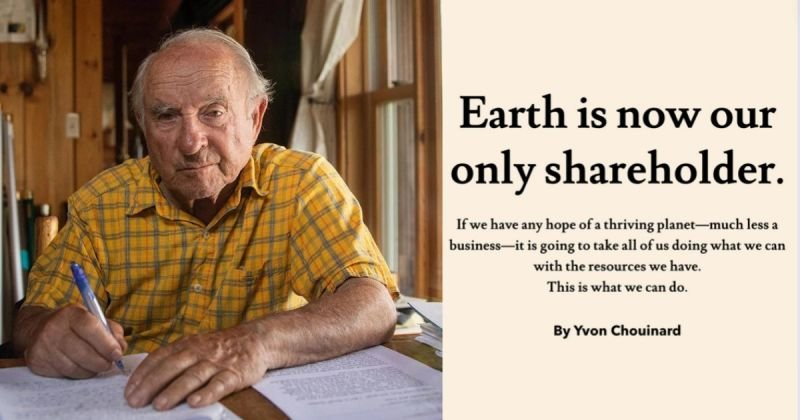
Then, in 2022, founder Yvon Chouinard took his most dramatic step. Rather than selling the company or taking it public, he and his family transferred ownership so that Patagonia's profits would be used to fight climate change and protect undeveloped land. As Chouinard famously put it, "Earth is now our only shareholder."
What's remarkable is not any single decision. It's the willingness to repeatedly question assumptions that most companies never challenge.
The lesson isn't that every company should give away its profits. It's to ask a different question: What assumptions about money, ownership, incentives, or success has your industry accepted as fixed that could be reinvented?
Conclusion
What I love most about Patagonia is the company's willingness to question assumptions that the rest of the industry takes for granted.
Should we hide our shortcomings or talk about them openly?
Should we only innovate our products or rethink the entire customer experience?
Should business exist solely to maximize profits, or can it serve a larger purpose?
Again and again, Patagonia chose the less obvious path. In doing so, it built one of the most trusted and enduring brand stories in the world.
The lesson for the rest of us is simple: A mission is not a slogan. It's a decision-making tool. Patagonia's mission didn't tell the company what to say; it told the company what to do. The most powerful opportunities often hide inside assumptions no one else thinks to challenge.
If you'd like to learn more about the company and the unconventional thinking behind it, I highly recommend reading Dirtbag Billionaire: How Yvon Chouinard Built Patagonia, Made a Fortune and Gave it All Away.
It's a fascinating look at how Patagonia became Patagonia—and a reminder that great stories aren't just told. They're lived.