

Positioning Leader Spotlight
Meet Matt Glickman, CEO of Genesis Computing

Matt Glickman’s career spans some of the most defining chapters in data and AI, from building early data systems for quants at Goldman to helping shape product during Snowflake’s rise. Two ideas ground his leadership philosophy: a people-first belief that trust and advocacy matter as much as technology, and a commitment to first-principles thinking that he credits to his years working with world-class quants. At Snowflake, he saw that customers chose the company because they believed in the people behind the product. At Goldman, he learned to strip decisions down to fundamentals rather than follow industry assumptions. Today, as CEO of Genesis Computing, those two principles guide how he leads, how he builds, and how he positions the next wave of enterprise AI.
What early experiences, challenges, or mentors shaped your approach to leading teams today?
“Approaching data engineering from first principles has allowed Genesis to stand out from the noise. Instead of bolting on single-shot SQL and code generator copilots, we are rethinking and reinventing what an AI data engineer can do that a human never could.”
During my early days leading Product at Snowflake, I spent those first few years alternating between a week on the West Coast meeting with Snowflake’s CEO, Bob Muglia and the Engineering team, and then a week on the East Coast meeting with customers. I’m not sure if he meant to be this prophetic, but Bob made a keen observation one day that really stuck with me: “when things are going well, it becomes unclear to customers where the silicon stops and carbon begins.” Effectively the people at Snowflake are an integral part of the product and a critical reason why customers were choosing us. I saw this first hand when customers chose us because they believed that Snowflakes like me not only really understood their business use case, but they were also buying because they knew that we would advocate for their needs in the product going forward. I think about this “people-first” approach a lot as it has already been a critical differentiator for why customers are choosing to go on their enterprise AI journey with Genesis.
Before Snowflake I spent my early career years building data systems and leading data platform teams for Strats—what Goldman calls quants. I worked for Armen Avanessians during the bulk of those formative years. Before it became a thing that Elon Musk would evangelize about on social media, I learned from Armen the importance of “first principles thinking” instead of what people typically do which is making decisions by analogy. Approaching data engineering from first principles has allowed Genesis to stand out from the noise. Instead of bolting on single-shot SQL and code generator copilots, we are rethinking and reinventing what an AI data engineer can do that a human never could.
When you think about positioning as a form of leadership, what does that look like in practice?

From pitching Snowflake in 2015 to Snowflake investing in Genesis today, clarity has been the constant.
Given the increased speed of development in the AI age, it’s more important than ever for your team and your customers to understand your positioning and where the company and product are going. Without this clarity, critical engineering cycles will be wasted and customers could lose faith—both of which could limit the chances of the company achieving its mission.
With that in mind, founders play a particularly critical role in defining the mission, plotting a course and leading with a steady head to succeed at that mission. I witnessed the best example of this clarity of vision starting from the first day I met Snowflake’s founder, Benoit Dageville, when he and Snowflake came to pitch me and my fellow Goldman colleagues on that fateful day in 2015. That kind of clarity is very rare but I’m proud to say I see a similar clarity when my co-founder, Justin Langseth, explains the Genesis agentic data approach to customers and it is super powerful and confidence inspiring when it’s that genuine.
How has clear positioning changed the trajectory of your business?
The key insight we had early on that has resonated most with customers was inspired by our own collective, formative years working in data-heavy industries: enterprises are run today by pooling the collective institutional knowledge that exists in all of the employees' brains. Up until now, most data workflows were either too complicated or too expensive to fully automate, migrate or optimize. Embracing Genesis to extricate this knowledge and transform it from a liability into an asset has been a key inflection point for us. We’ve even had several customers tell us that we “had them at documenting their workflows” and they are only half-joking.
AI agents are redefining how enterprises work with data. What did the ZOOM positioning process help you uncover about how to tell that story?
What ZOOM’s process helped crystallize, and what ultimately catapulted Genesis to be a leader in this AI data wave, was the focus on “enterprise readiness.” The key parts of the ZOOMing process that brought these insights to light were the respectful yet no-nonsense "I don't get it" Ellie moments. Knowing that we had to pass the Ellie test made us do the extra work to simplify our positioning. Having worked in and sold to many regulated, data sensitive enterprises, we know from experience that the typical naive approach of build-your-own agents for data will not cut it in the real world. Enterprises are looking for AI solutions that solve business problems out of the box that run securely in their own infrastructure.
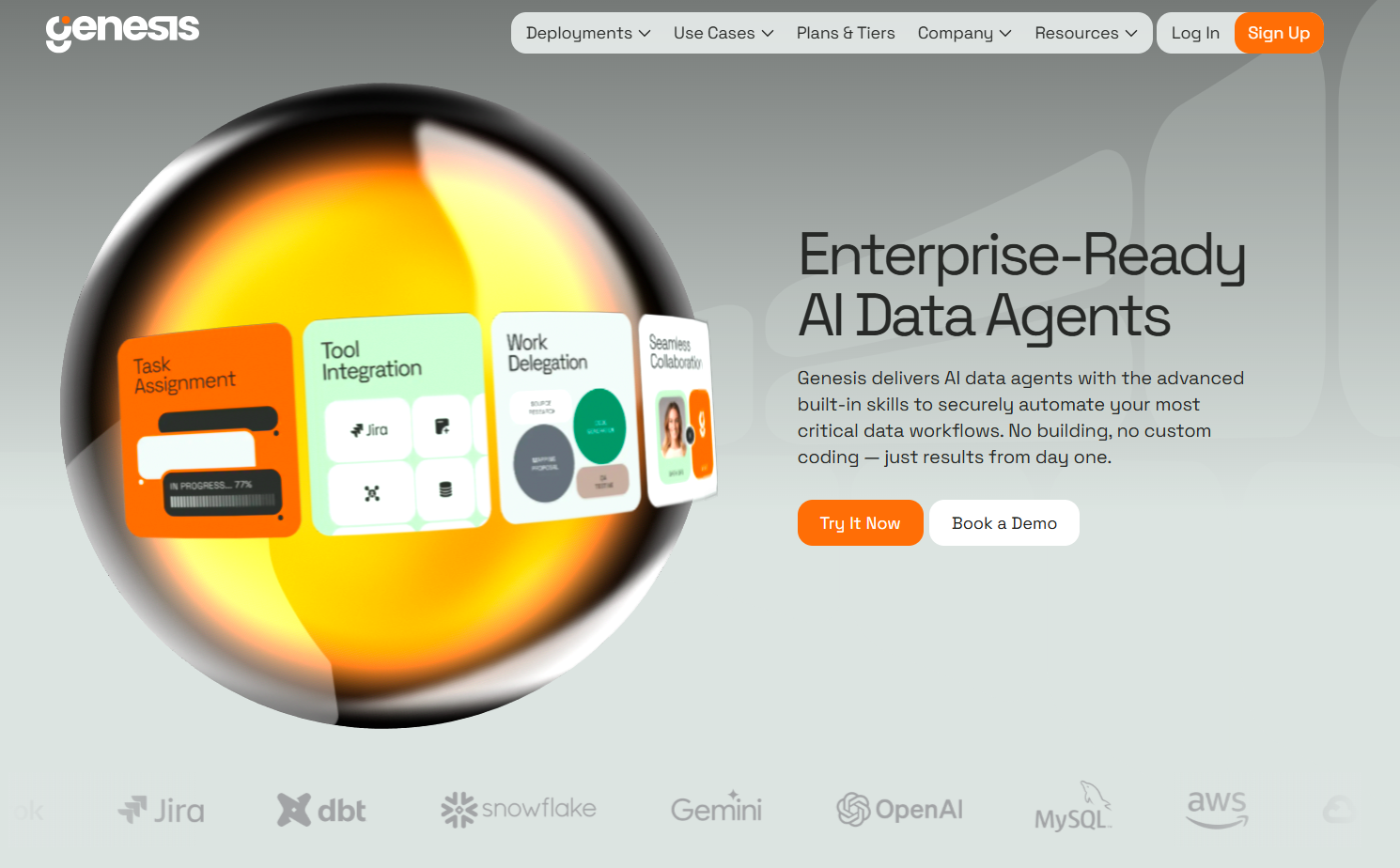
ZOOM’s no-nonsense clarity test shaped this: AI agents that work securely in the real world, right out of the box.
How did you bring your team along on the positioning journey, and what advice would you give other leaders trying to do the same?
“We use our all-hands to share excitement and provide transparency into what we are working and most importantly, why. ”
Always be selling! It’s just as important to sell how your company’s positioning internally as it is selling to customers. Each engineer, marketer, salesperson, ops, financer—everyone—needs to understand how what they are working on fits into the company vision so it had better be believable and convincing.
This is put into practice during weekly all-hands where we bring the entire company together. We use this meeting to share excitement and provide transparency into what we are working and most importantly, why. We've recently changed the format of the all-hands from an around-the-horn recap, to highlighted speakers explaining what they are working on, framed by me as to why it's important. The excitement and level that we come out of these all-hands with everyone feeling like they are part of the mission is palpable.
Which company’s positioning do you most admire—and what can today’s leaders learn from it?

Formula1 shifted from a niche motorsport to a global phenomenon that blends technology, storytelling, and community.
Formula 1 is one of the best examples of repositioning in recent years. It shifted from being a niche motorsport for motorheads to a global phenomenon that blends technology, storytelling, and community. The sport didn’t change its core. It changed how people understood its value. Behind the spectacle is a data-driven ecosystem where every decision, from tire choice to race strategy, is informed by continuous feedback.
That repositioning turned F1 into a masterclass in aligning precision engineering with emotional engagement. I see a similar opportunity in enterprise AI: to make complex systems visible, relatable, and valuable at every level of the organization. Genesis aims to do for data operations what F1 did for motorsport—bring intelligence, performance, and human mastery into the same frame.